Evaluating 4 Grey Floral Mandala Page Backgrounds for Professional Design Projects
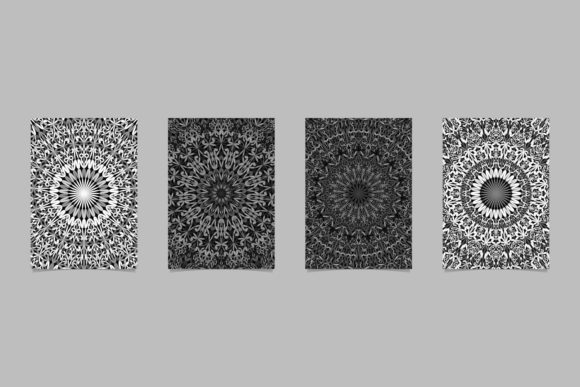
Selecting the right visual foundation for stationery and digital layouts requires balancing aesthetic appeal with functional utility. The 4 Grey Floral Mandala Page Backgrounds set offers a specific solution for designers seeking ornate yet unobtrusive patterns. This collection, featuring symmetrical vector stationery designs in a high-resolution JPG format (12000x4000) and editable EPS files, targets a niche within surface pattern design. Understanding the technical specifications and practical applications of this grey abstract flower garden mandala poster background template set is essential for determining if it aligns with current project requirements.
Defining the Asset: Technical Specifications and Visual Characteristics
The core value of this asset lies in its dual-format delivery and substantial resolution. The inclusion of both JPG and EPS formats addresses different stages of the design workflow. The 12000x4000 pixel JPG files provide immediate, rasterized backgrounds suitable for digital mockups, web headers, or quick proofs without requiring specialized vector software. Conversely, the EPS (Encapsulated PostScript) files serve as the master source, allowing for infinite scaling and color manipulation. This distinction is critical for professional output; while the JPG is convenient, the EPS ensures print fidelity at any physical dimension.
Visually, the set focuses on grey tonalities rather than full-spectrum color. This monochromatic approach transforms the mandala from a focal point into a textural element. The "abstract flower garden" description indicates a stylized interpretation of botanical forms, prioritizing symmetry and rhythm over realistic depiction. For stationery design, this abstraction is often preferable to literal imagery, as it reduces visual noise and prevents competition with typography or logo placement. The four distinct variations provide enough diversity to create a cohesive brand suite—such as matching letterheads, envelopes, and business cards—without appearing repetitive.
Strategic Applications in Stationery and Print Design
Designers evaluating this set should consider its primary strength: versatility through neutrality. Grey floral mandalas function effectively as watermark-style backgrounds where high contrast would be detrimental. In corporate stationery, wedding invitations, or certificate design, legibility is paramount. A black-and-white mandala might feel too stark or severe, while a colorful one could clash with brand guidelines. The grey palette acts as a bridge, adding sophistication and organic warmth without compromising readability.
The ultra-wide aspect ratio (3:1) of the 12000x4000 files warrants specific consideration. This dimension is optimized for panoramic applications such as website hero banners, social media cover photos, or wide-format packaging sleeves. However, for standard A4 or Letter-sized stationery, users must plan for cropping or tiling. The vector nature of the EPS files mitigates this limitation significantly. Unlike raster images that lose quality when resized, the vector artwork can be re-artboarded, elements can be rearranged to fit vertical orientations, and density can be adjusted to suit the specific medium. This adaptability makes the set more valuable than a simple pack of fixed-ratio textures.
Benefits and Functional Advantages
The decision to utilize this specific template set often hinges on workflow efficiency and aesthetic consistency. Several key benefits distinguish it from generic texture packs:
- Editability and Customization: The EPS format allows designers to isolate individual floral motifs. If a full-page mandala is too busy for a business card back, specific vector paths can be extracted to create subtle corner accents or border elements.
- Print-Ready Resolution: At 12000 pixels wide, the raster files support large-format printing at high DPI. This eliminates the common pitfall of pixelation when moving from digital proofing to physical production.
- Tonal Flexibility: Grey vectors are inherently easier to recolor than complex multi-colored illustrations. Applying a global color swatch change in Adobe Illustrator can instantly adapt the entire set to match a client’s specific Pantone or CMYK values.
- Symmetrical Balance: Pre-made symmetrical compositions save hours of manual alignment. For projects requiring classical balance and formality, these templates provide an immediate structural foundation.
Tradeoffs and Limitations to Consider
Despite its advantages, the 4 Grey Floral Mandala Page Backgrounds set presents specific constraints that may not suit every project. Objective evaluation requires acknowledging these tradeoffs:
- Aspect Ratio Constraints: As noted, the 3:1 ratio is non-standard for traditional document design. Users working exclusively with vertical portraiture formats will need to spend time restructuring the vector art rather than simply dropping in a background.
- Stylistic Specificity: Mandalas carry distinct cultural and aesthetic associations. They imply mindfulness, tradition, or bohemian elegance. This style may conflict with ultra-modern, minimalist, or industrial brand identities. The "grey" modifier softens the look, but the fundamental geometry remains dominant.
- Vector Skill Requirement: To fully leverage the EPS files, users must possess proficiency in vector editing software. Those relying solely on raster editors like Photoshop or Canva will be limited to the JPG files, negating the scalability benefits and restricting customization options.
- Licensing Verification: Template sets vary widely in licensing terms. Before commercial deployment, users must verify whether the license permits end-product sales, modification, or use in trademarked branding. Assuming universal commercial rights is a common risk with digital assets.
Determining Fit: When to Choose This Set vs. Alternatives
Decision-making should be driven by project goals rather than mere availability. This mandala set is a strong fit when the objective is to add decorative complexity without introducing chromatic chaos. It excels in contexts where the background must support content rather than dominate it. Wedding stationery suites, spa and wellness branding, yoga studio collateral, and heritage-style certificates are ideal use cases. The grey tone specifically supports projects where text hierarchy is critical, as it recedes visually while maintaining presence.
Conversely, alternatives should be considered in several scenarios. If the project demands bold, contemporary expressionism, geometric minimalism, or photographic realism, a mandala template will likely feel incongruent. Additionally, if the final output is strictly small-format digital (e.g., app icons or thumbnails), the high-resolution detail of this set may be unnecessary overhead; simpler, lower-res patterns would suffice. For users lacking vector editing capabilities who require vertical layouts, seeking pre-formatted A4/Letter raster backgrounds may prove more time-efficient than adapting these panoramic files.
Practical Implementation Insights
For those proceeding with this asset, maximizing its potential involves strategic layer management. When using the EPS files, keep the mandala on a separate layer beneath all typography and logos. Utilize opacity masks or gradient overlays to fade the edges of the pattern, ensuring that text placed near margins remains crisp. Testing print outputs early is advisable; grey tones can shift between screen (RGB) and press (CMYK), and what appears as a subtle texture on-screen may print too dark or too light depending on paper stock. Uncoated papers tend to absorb ink, making greys appear richer, while coated stocks maintain higher contrast.
Ultimately, the 4 Grey Floral Mandala Page Backgrounds represent a specialized tool rather than a universal solution. Their value is realized when a designer needs scalable, neutral, symmetrical ornamentation and possesses the technical skills to adapt the vector source material. By weighing the flexibility of the EPS format against the stylistic specificity of the mandala motif, professionals can make informed decisions that enhance rather than hinder their design objectives. Careful evaluation of these factors ensures the asset serves as a productive component of the creative toolkit.